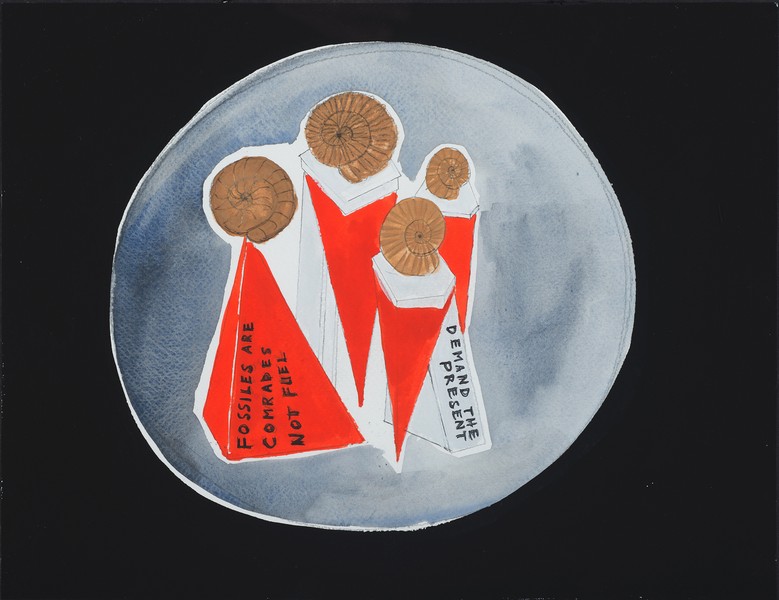
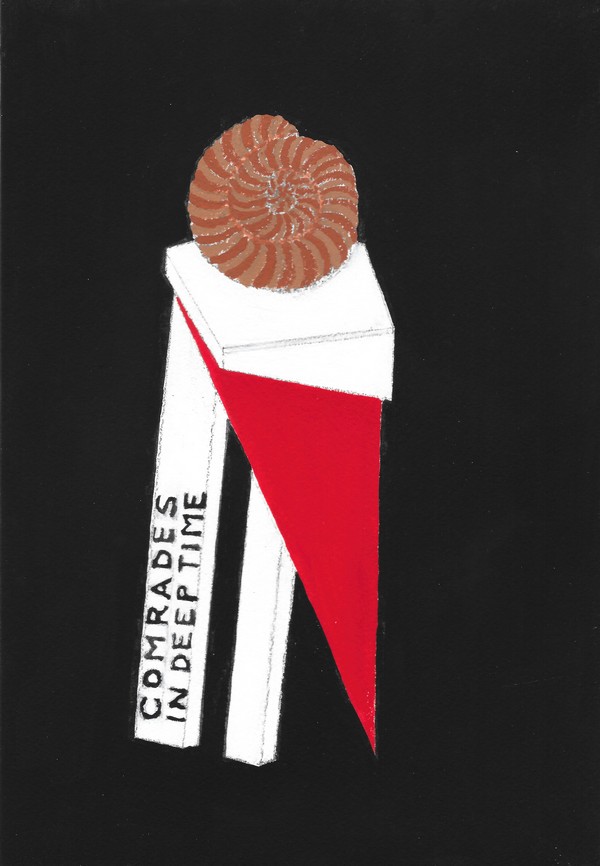
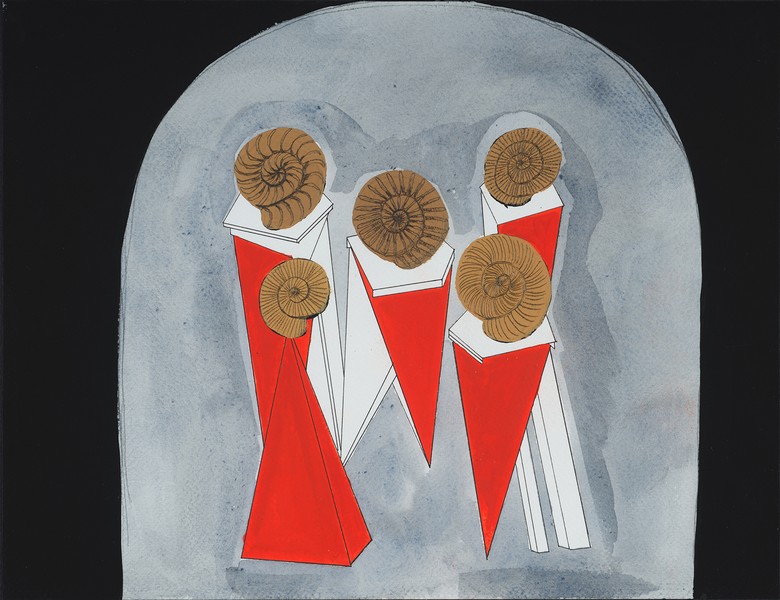
The work of Dutch artist Jonas Staal is focused on (emancipatory) propaganda art. In this installation of what he calls "neo-constructivist ammonites", he builds on the heritage of the Russian constructivists and productivists such as Alexander Rodchenko and Varvara Stepanova that spoke of revolutionary objects as "comrades". The idea of these artists was that in the Soviet Union objects would not just be shared property, but they would be revolutionary agents in their own rights.
Staal expands this theory of the object-as-comrade to include other non-humans, by constructing neo-constructivist "bodies" for ammonite fossils from Imouzzer Ida Ou Tanane (Morocco) that are between 66 and a million years old. This now extinct shelled mollusk is closely related to the octopus and squid, and dominated the earth's oceans until it perished in the 5th mass extinction. Their neo-constructivist extensions serve to recognize non-human comradeship in a time in which human species face the unfolding of the 6th mass extinction of their own making. Through slogans such as "Comrades in Deep Future," "Demand the Present" and "Collectivize Extinction", the neo-constructivist ammonites invite for a multispecies transhistorical dialogue, from deep past to deep future, to deepen solidary co-existence in the present.
Alongside the installation, Staal selected works from the constructivist and productivist artists from the Costakis collection in which the idea of the "object-as-comrade" becomes visible. Gustav Klutsis' studies Agitprop of Communism (1922) and Design for Propaganda Kiosk (1922) were meant to propagate the objectives of the revolution through loudspeakers, slogans and newspapers, but also look like a kind of personalities themselves. Varvana Stepanova's Composition (Head) (1920) and Gustav Klutsis' Photomontage with a Portrait of Lenin (undated) show a merger of the revolutionary human and comradely object, in which they have turned into new shared hybrid bodies. Alexander Rodchenko's Construction No.3 (1921) is a human-like machine, or machine-like human, whereas his Dots, Composition No.117 (1920), evokes a view of outer space with comradely constellations of colorful stars.
Although the work of the artists from the Russian revolution and that of Staal differ a century, they show that constructivism continues to be a contemporary language through which, in a time of existential crises, new forms of comradeship can be imagined and practiced between human, non-human and more-than-human subjectivities.
Jonas Staal